Deep Technical Dive
Project Blaze — Smart Emergency Alert Ring
A wearable IoT safety ring that sends emergency alerts and live location using LoRa with satellite fallback in network-deficient regions.
ESP32NEO-6M GPSRFM95W LoRaSatellite CommunicationPressure SensorLi-Po BatteryCloud AlertsMobile App
Problem
Emergency incidents often happen in areas with poor or no cellular coverage, where smartphones and conventional wearables fail to send distress messages reliably.
Project Context
- • Project Blaze was conceived as a practical personal-safety device for remote and high-risk environments.
- • The design prioritizes instant distress signaling when users cannot safely access a phone.
Why It Was Hard
- • Reliable emergency messaging in weak-network regions requires multi-channel communication design.
- • Wearable form factor imposes strict constraints on battery, antenna behavior, and component integration.
- • False triggers must be minimized without slowing emergency response time.
Solution
Built a compact, self-contained emergency ring that uses pressure-based SOS activation, GPS location retrieval, LoRa long-range transmission, and satellite fallback to deliver alerts even without mobile network access.
System Architecture
Diagram space is ready — replace with visuals later if needed.
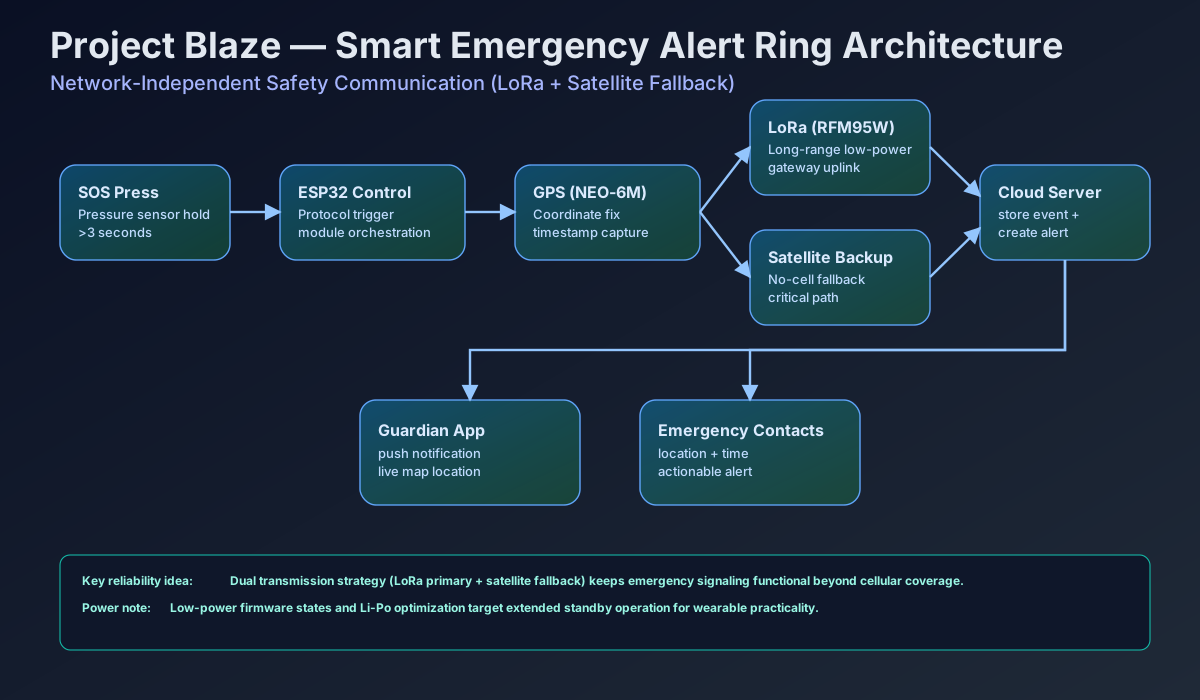
- • User presses SOS button on ring
- • ESP32 microcontroller triggers emergency workflow
- • GPS module retrieves real-time coordinates
- • Emergency payload formed (device ID + coordinates + timestamp)
- • Data transmission via LoRa or satellite fallback
- • Cloud server stores event and generates encrypted notifications
- • Guardian mobile app receives live alert and map location
Implementation
- • Integrated ESP32 as central controller for sensor input, GPS polling, transmission selection, and feedback handling.
- • Implemented pressure-sensor hold logic (>3s) to reduce accidental trigger events during daily use.
- • Added vibration motor confirmation to provide silent tactile acknowledgement after SOS activation.
- • Connected NEO-6M GPS for coordinate capture with fallback estimation strategy when signal quality is weak.
- • Configured RFM95W LoRa path for long-range low-power emergency messaging and added satellite backup route.
- • Designed cloud processing flow for secure event persistence and push-notification dispatch to guardians.
- • Optimized firmware sleep cycles and power states for extended standby battery life (~48 hours target).
Results
- • Delivered network-independent emergency signaling in scenarios where cellular service is unavailable.
- • Enabled real-time guardian awareness through instant SOS notifications and map-ready coordinates.
- • Validated discreet wearable activation for high-stress or high-risk personal safety situations.
- • Achieved practical standby performance through low-power embedded operation design.
- • Demonstrated adaptability across women’s safety, child tracking, elderly care, and remote adventure contexts.
Lessons Learned
- • Emergency communication systems must not depend only on cellular infrastructure.
- • Combining LoRa and satellite fallback significantly improves delivery reliability.
- • Simple activation gestures perform better than complex interactions in stressful moments.
- • Wearable adoption depends equally on comfort, discretion, and technical reliability.
Privacy & Security Design
- • Emergency payloads are transmitted with device identity and timestamp controls for traceability.
- • Server-side notification flow is designed with encrypted alert handling.
- • Only SOS-relevant location events are shared to designated guardians for safety use-case boundaries.
Future Improvements
- • Geofencing alerts for proactive guardian notifications.
- • Two-way acknowledgement from guardians/emergency services.
- • Health telemetry integration (fall detection / heart-rate anomaly triggers).
- • Ruggedized hardware revision for harsh industrial and outdoor conditions.