Deep Technical Dive
rPPG-Based Contactless Blood Pressure Monitoring System
A computer-vision health monitoring system that estimates heart rate, respiration, and blood pressure from short facial video without physical sensors.
PythonOpenCVNumPyrPPGSignal ProcessingTensorFlow/PyTorchFacial Landmark Tracking
Problem
Traditional blood-pressure monitoring depends on contact-based hardware such as cuffs and wearable sensors, which can be inconvenient for frequent or remote monitoring scenarios.
Project Context
- • The project explores non-invasive vital estimation for remote healthcare and wellness applications using only camera input.
- • It demonstrates how computer vision, signal processing, and ML can be combined for practical contactless monitoring.
Why It Was Hard
- • Physiological color variations are extremely subtle and easy to drown in noise.
- • Movement, lighting changes, and camera quality directly impact signal reliability.
- • Blood-pressure inference from rPPG is an indirect estimation task requiring robust feature learning.
Solution
Built a contactless pipeline that captures a short facial video, validates face/eye/motion quality, extracts rPPG waveforms from facial ROI, applies denoising and normalization, and predicts systolic/diastolic pressure through ML inference.
System Architecture
Diagram space is ready — replace with visuals later if needed.
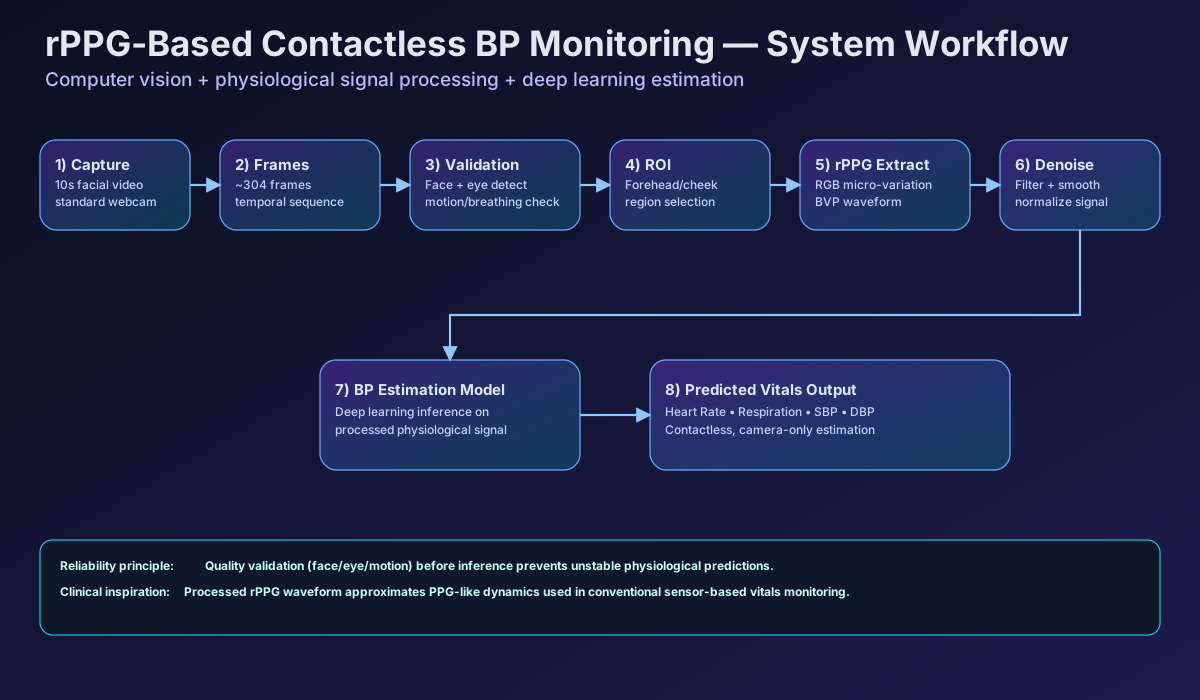
- • User video capture (10 seconds)
- • Frame extraction (~304 frames)
- • Face and eye detection
- • Quality validation (motion/breathing/stability)
- • ROI selection (forehead/cheek regions)
- • rPPG signal extraction from RGB variations
- • Signal processing (temporal filtering + smoothing + normalization)
- • Deep learning BP estimation model
- • Predicted output: HR, respiration, SBP, DBP
Implementation
- • Implemented short webcam-based acquisition flow and converted recordings into dense frame sequences for stable physiological analysis.
- • Developed validation gates for face presence, eye alignment, motion stability, and respiration plausibility before model inference.
- • Extracted blood-volume pulse proxies using rPPG from selected facial ROI by tracking subtle RGB skin-tone fluctuations.
- • Applied temporal filtering, smoothing, and amplitude normalization to suppress motion and illumination artifacts.
- • Integrated neural estimation model to infer systolic and diastolic blood pressure from processed physiological waveform features.
- • Built evaluation scripts to compare predicted vitals behavior across controlled capture conditions.
Results
- • Demonstrated practical contactless extraction of heart rate, respiration trend, and blood-pressure estimates from standard camera input.
- • Reached strong controlled-setting BP estimation performance (~89% overall estimation accuracy baseline).
- • Validated that high-frame-count short captures improve rPPG signal stability and downstream prediction quality.
- • Showed real potential for telemedicine and remote monitoring workflows without specialized cuffs during quick screening.
Lessons Learned
- • Signal quality is the dominant factor in video-based physiological estimation.
- • Lighting variation and facial motion require explicit compensation to avoid unstable inference.
- • Validation checks before inference are essential for trustworthy medical-adjacent outputs.
- • rPPG pipelines can enable low-cost, camera-first health screening when carefully engineered.
Privacy & Security Design
- • Pipeline can be operated with transient frame processing to reduce long-term storage of sensitive video.
- • Only required physiological outputs need to be persisted for monitoring workflows.
- • Design is compatible with local/on-device processing goals for privacy-focused telehealth deployments.
Future Improvements
- • Add illumination-invariant normalization for uncontrolled real-world environments.
- • Improve robustness under head movement with stronger ROI tracking and compensation.
- • Integrate personalized calibration for improved SBP/DBP estimation consistency.
- • Extend to mobile deployment for at-home screening and telemedicine integration.